
Orthodontics
This page contains the documents that relate to the Dental Specialty Fellowship Examinations for this topic.
- Examination Syllabus
- Assessment strategy
- Link to the GDC Curriculum
- Link to the training syllabus defined by the Specialty Advisory Committee (SAC)
- Illustration of how the change to the curriculum impacts the examination certifications.
- Development of the Orthodontics Advanced Fellowship
- Orthodontics Post-CCST Note
- Part 1 SBA Sample Questions
- Part 1 Exam Specification
Examination Syllabus
Assessment Strategy
GDC Curriculum and Training Syllabus


Training syllabus – As defined by the Specialty Advisory Committee (SAC)
Illustrative Examination Route
The image below is to illustrate the changes to certification as a result of the introduction of the new curriculum. The illustration assumes full time training. Trainees on the NTN pathway should refer to their TPD’s or Post Graduate Dental Dean for information about progression.
Part 1 Sample Questions
Below are five sample Single Best Answer (SBA) questions selected from across the syllabus. These questions are designed to be indicative of the level, style, and cognitive demand of the examination and reflect the use of higher‑order clinical reasoning. They are provided solely as a guide and should not be interpreted as representative of the full breadth or specific content of the assessment.
You will be required to select the most appropriate answer from a choice of five answers. There may be images and/or test results included in the data provided for the question.
The examination comprises two papers of 90 SBA questions, each of two hours’ duration. There is no negative marking, and candidates are therefore encouraged to attempt every question. During each paper, candidates will be able to navigate freely between questions and amend their answers at any point prior to submission. Further information on the in-centre assessment experience will be made available on the website and in direct communications to registered candidates.
Question 1
A 9-year-old male patient attends for a routine assessment. Clinically, he presents with a Class I malocclusion in the mixed dentition. On radiographic examination, an unerupted supernumerary is identified in the anterior region of the maxilla. Medically, he is fit and well.
Based on morphology, what is the most likely supernumerary to be present?
A. Conical type
B. Tuberculate type
C. Supplemental type
D. Complex odontoma
E. Compound odontoma
The correct answer is A.
Justification: Conical supernumeraries are the most common type of supernumerary found in the anterior maxilla.
Question 2
A 10-year-old male child is referred to a specialist orthodontic practice. He presents in the early mixed dentition with Class I incisors on a Class I skeletal base with an average overjet and overbite and well-aligned dental arches. The buccal relationship is Class I. The UR3 is buccally palpable, but the UL3 is not palpable. An orthopantomogram (OPG) radiograph is taken (as shown).
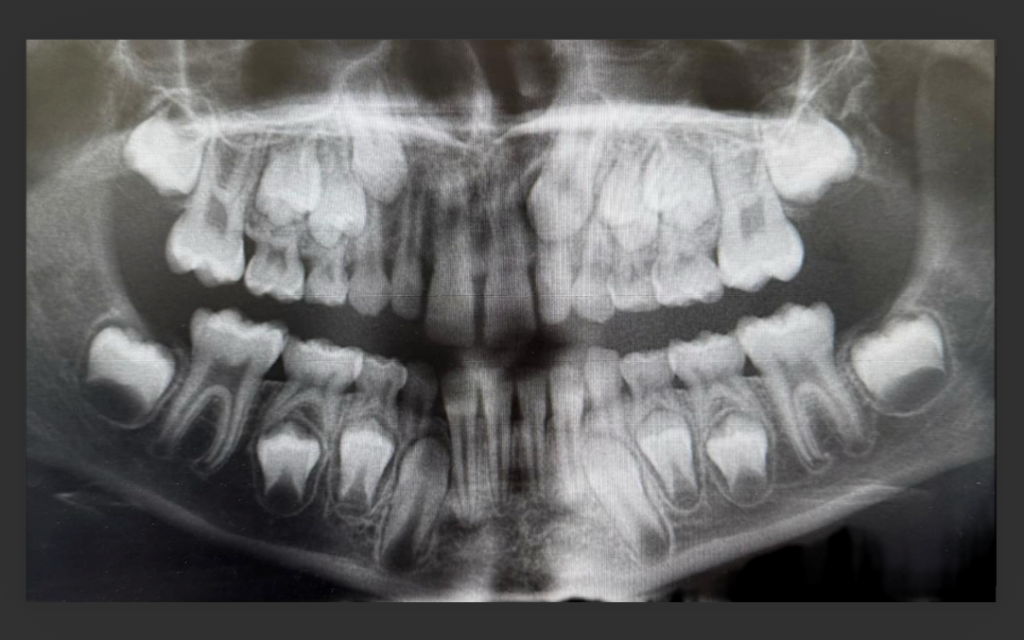
What is the most appropriate management for this patient?
A. Arrange extraction of the LLC and monitor the eruption of the LL3
B. Arrange the extraction of URC and ULC, provide a space maintainer and monitor dental development
C. Plan to fit rapid maxillary expansion device and lower lingual arch and monitor the eruption of the UL3 and UL3
D. Plan to fit an upper distilisation device and monitor the eruption of the UL3 and UL3
E. Refer the patient to oral surgery for the surgical exposure of the UL3
The correct answer is B.
Justification: There are no indications for extraction of the LLC, early treatment to expand the upper arch or increase the upper arch length by distilisation or surgical exposure of the UL3.
Question 3
A 14-year-old male patient attends for an orthodontic assessment. Clinically, he presents with a Class III malocclusion and reverse overjet.
Which of the following findings would indicate that orthodontic camouflage is likely to be a suitable treatment option?
A. A younger patient with no forward mandibular displacement on closing
B. Absence of any forward mandibular displacement and an increased maxillary-mandibular plane angle
C. An increased maxillary-mandibular plane angle and an anterior open bite
D. In retruded contact position, edge-to-edge incisor relationship and reduced maxillary-mandibular plane angle
E. Proclined upper and retroclined lower incisors
The correct answer is D.
Justification: In a Class III malocclusion, orthodontic camouflage is more favourable when the patient has reduced to average vertical proportions, there is minimal dental compensation, and the patient can achieve an edge-to-edge incisor relationship in the retruded contact position.
Question 4
A 15-year-old male patient attends for a Twin Block appliance review. The appliance has been worn infrequently for the last year. Clinically, the patient has a Class II Division 1 malocclusion on a severe Skeletal 2 base with increased vertical proportions. During treatment the overjet has remained at 10 mm, and the molar relationship is a full unit Class II bilaterally. The patient is very unhappy about the appearance of his prominent front teeth and jaw profile.
What is the most appropriate next step in the management of this patient?
A. Cease current treatment and review to consider a future combined orthodontic and orthognathic surgery approach
B. Cease current treatment, due to poor compliance, and discharge
C. Encourage increased functional appliance wear and review in eight weeks
D. Undertake orthodontic camouflage with upper and lower fixed appliances and extraction of UR4 and UL4
E. Undertake orthodontic camouflage with upper and lower fixed appliances and extraction of UR4, UL4, LL4 and LR4
The correct answer is A.
Justification: The patient has demonstrated reduced compliance with the functional appliance. Additionally, the patient has profile concerns on a severe Skeletal II base, therefore undertaking orthodontic camouflage is not indicated.
Question 5
A patient attends with a malocclusion complicated by hypodontia of the upper lateral incisors and a reduced overbite. The treatment plan involves using upper and lower fixed appliances to open spaces to accommodate prosthetic tooth replacement for the upper lateral incisors bilaterally. A periapical radiograph is taken to assess the root position prior to debond. A rectangular stainless-steel archwire has been previously ligated.
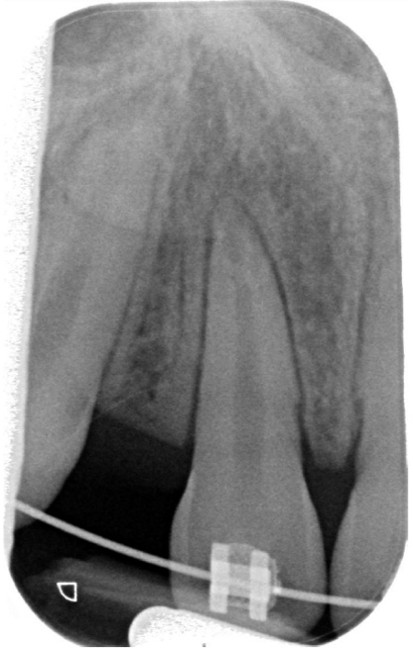
What is the most appropriate next step?
A. Change the plan and close space on the UR2 region, as space is limited
B. Debond the UR1 immediately and request a review with the dentist regarding the widening of the periodontal ligament
C. Place a third order bend on the UR1 to improve the root position
D. Proceed with debond as planned and arrange a post-debond restorative dentist/general dental practitioner (GDP) review
E. Reposition the bracket on the UR1 with mesial root tip and arrange a restorative dentist/GDP review
The correct answer is E.
Justification: The treatment plan is to open space for the replacement of the UR2 and UL2. At this stage, removal of the appliances is not indicated, as there is no pathology and the optimal inter-radicular space has not been achieved. A third order bend will not address the UR1 root angulation.