
Paediatric Dentistry
This page contains the documents that relate to the Dental Specialty Fellowship Examinations for this topic.
- Examination Syllabus
- Assessment strategy
- Link to the GDC Curriculum
- Link to the training syllabus defined by the Specialty Advisory Committee (SAC)
- Illustration of how the change to the curriculum impacts the examination certifications
- Part 1 SBA Sample Questions
- Part 1 Exam Specification
Examination Syllabus
Assessment Strategy
GDC Curriculum and Training Syllabus


Training syllabus – As defined by the Specialty Advisory Committee (SAC)
Illustrative Examination Route
The image below is to illustrate the changes to certification as a result of the introduction of the new curriculum. The illustration assumes full time training. Trainees on the NTN pathway should refer to their TPD’s or Post Graduate Dental Dean for information about progression.
Part 1 Sample Questions
Below are five sample Single Best Answer (SBA) questions selected from across the syllabus. These questions are designed to be indicative of the level, style, and cognitive demand of the examination and reflect the use of higher‑order clinical reasoning. They are provided solely as a guide and should not be interpreted as representative of the full breadth or specific content of the assessment.
You will be required to select the most appropriate answer from a choice of five answers. There may be images and/or test results included in the data provided for the question.
The examination comprises two papers of 90 SBA questions, each of two hours’ duration. There is no negative marking, and candidates are therefore encouraged to attempt every question. During each paper, candidates will be able to navigate freely between questions and amend their answers at any point prior to submission. Further information on the in-centre assessment experience will be made available on the website and in direct communications to registered candidates.
Question 1
A 4-year-old child presents with a sudden onset of painful mouth ulcers and refusal to eat. The parent reports that the child has had a fever, malaise and swollen glands for two days. On examination, there is generalised erythematous gingivitis with bleeding, cervical lymphadenopathy and multiple small painful ulcers affecting the lips, tongue, buccal mucosa and gingivae.
What is the most likely diagnosis?
A. Recurrent aphthous stomatitis
B. Primary herpetic gingivostomatitis
C. Hand, foot and mouth disease
D. Acute necrotising ulcerative gingivitis
E. Pyostomatitis vegetans
The correct answer is B.
Justification: This is correct answer due to patients age, sudden onset of painful oral ulceration, and systemic symptoms including fever, malaise and cervical lymphadenopathy. The other options are less likely as do not present with systemic features or this ulceration pattern.
Question 2
A 12-year-old is referred to the clinic after sustaining trauma to the LL1 three weeks ago. A radiograph confirms a horizontal root fracture. The coronal fragment was slightly mobile but not displaced at the time of injury and the tooth was splinted. On examination, the affected tooth is not tender to percussion, there is no sinus or swelling and sensibility testing gives no response.
What is the most appropriate next step in management?
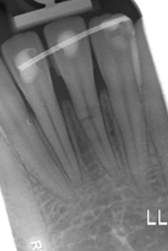
A. Remove the splint immediately and arrange for clinical review in 4-weeks
B. Maintain the splint for a further week, then review clinically and radiographically
C. Begin root canal treatment of the LL1 to the fracture line immediately
D. Begin root canal treatment of the entire root canal system and remove the splint at the same visit
E. Extract the LL1 and provide a removable prosthesis as in interim space maintainer
The correct answer is B.
Justification: This is correct answer as advice for a root fracture is to splint for approximately four weeks. As the injury occurred three weeks ago and the tooth was splinted at the time, continuing the splint for one further week is appropriate before reassessment. Although the tooth gives no response to sensibility testing, this does not necessarily indicate pulp necrosis at this stage. In the absence of signs of infection immediate root canal treatment is not indicated.
Question 3
A 12-year-old child is referred to the paediatric dental clinic because the UR1 has failed to erupt. UL1 erupted over one year ago. There is no history of trauma. On examination, the upper right primary incisors are retained and firm. A localised Cone Beam Computed Tomography (CBCT) image is provided, confirming an obstruction- a supernumerary tooth is impeding the eruption of the UR1.
What is the most appropriate management?
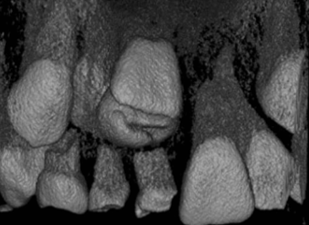
A. Extract the URA and URB to encourage eruption of the supernumerary tooth and UR1
B. Reassure the patient and review clinically and radiographically in 12 months
C. Surgically remove the supernumerary tooth and extract the URA and URB, then monitor for spontaneous eruption of the UR1
D. Surgically remove the supernumerary tooth and extract the URA and URB, and attachment of a gold chain
E. Extract the UR1 due to the ectopic position and retain the supernumerary tooth
The correct answer is D.
Justification: This is the correct answer as the child has delayed eruption of the UR1, retained firm primary incisors, and CBCT has confirmed that a supernumerary is obstructing eruption. Management should therefore remove the obstruction and the retained primary teeth. At this age/stage of development spontaneous eruption of the UR1 is less predictable, therefore attachment of a gold chain at the time of surgery is advised.
Question 4
A 12-year-old child with cystic fibrosis and a current respiratory tract infection becomes acutely breathless during restorative treatment, with persistent coughing, inability to complete sentences and oxygen saturation of 90% on room air.
What is the most appropriate immediate management?
A. Stop treatment, sit the child upright, give their reliever inhaler and resume only if symptoms settle
B. Stop treatment, place the child supine, give low-flow oxygen and contact the cystic fibrosis team
C. Stop treatment, sit the child upright, assess airway, breathing, circulation, disability, exposure (ABCDE) and give high-flow oxygen
D. Stop treatment, reassure the child, monitor oxygen saturation and avoid oxygen unless saturation falls below 85%
E. Stop treatment, prescribe antibiotics and defer further care until the respiratory infection has resolved
The correct answer is C.
Justification: The correct answer as these are signs of respiratory compromise and hypoxia. The immediate priority is to stop dental treatment, improve breathing and administer high-flow oxygen while urgent medical assistance is arranged. A structured ABCDE approach should be taken in a medical emergency.
Question 5
A 6-year-old child has caries affecting four primary molars. There is a history of dental pain and facial swelling, and the child has received two courses of antibiotics. The child was scheduled to attend the hospital for a general anaesthetic to have the teeth removed, but they have not been brought to the appointment.
What is the most appropriate next step in management?
A. Discharge the child from dental care at the hospital and write to their general dental practitioner
B. Place a safeguarding referral and write to their general medical practitioner
C. Contact the parent/carer urgently and assess the reason for non-attendance
D. Arrange another hospital appointment without further assessment
E. Refer the parent directly to the police
The correct answer is C.
Justification: This is the correct answer as this child has untreated dental disease, with a history of pain and infection. Non-attendance is therefore concerning. However, the most appropriate immediate step is to contact the parent or carer urgently to establish why the child was not brought, assess the level of concern, and decide what further action is required.